
The most useful send-time data point isn't “10 AM is best.” It's that opens and clicks peak at different times, and the gap is wide enough to change how a newsletter should be planned. MailerLite's analysis shows opens peak between 8 AM and 11 AM, while clicks peak between 8 PM and 9 PM (MailerLite's 2026 statistical analysis), which means the right hour depends on whether you care more about being seen or getting action.
Where this fits in a working newsletter programme: See the newsletter strategy playbook, the detail on newsletter cadence for accounting firms, or ask for newsletter service pricing.
Why Send Time Is a Lever Worth Pulling
The most consistent cross-platform pattern points to mid-week mornings. Industry benchmarks consistently show the strongest open-rate concentration around 10 AM in recipients' local time zones, with Tuesday, Wednesday, and Thursday as the most reliable days for general newsletter sends. That overlap matters because it gives you a defensible default, not a guess built on one isolated report.
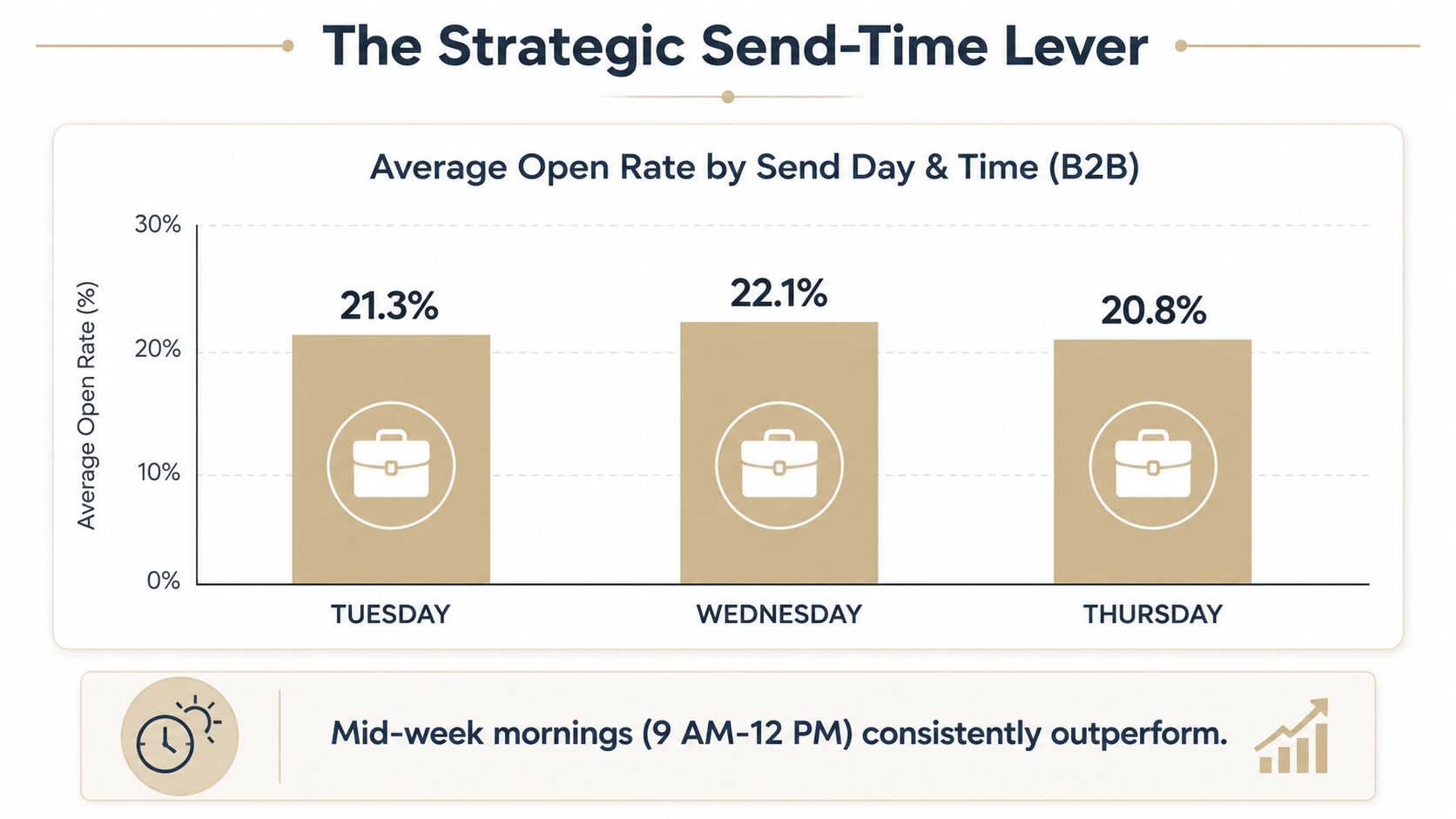
For B2B professional services firms, send time is one of the few variables you control every week. You cannot control subject-line competition, inbox clutter, or whether a partner is pulled into back-to-back calls. You can control whether your edition lands during workday triage or after the inbox has already filled up. That makes timing an operational lever, not a cosmetic choice.
Practical rule: if the list is broad and you need one default, start with a Tuesday–Thursday, 9 AM–12 PM local-time send window.
The business case is straightforward. Weekly newsletters compound. A small lift in visibility, repeated across a full year of editions, matters more than a one-time spike that never repeats. That is especially true in professional services, where newsletters are usually reminders that keep a firm familiar, credible, and present when a buying need eventually appears.
The better way to frame timing is by outcome. Opens and clicks do not peak at the same moment, so send time is not one question. It is two, and the answer changes depending on whether the goal is to get noticed or to get action.
Newsletter performance benchmarks and workflow context matter most when timing is treated as part of a weekly system, not a one-time guess. The rest of the article turns that system into a default, then shows where the default breaks.
The Morning Open-Rate Peak Explained
Cross-platform benchmarks consistently place the strongest open performance in the morning, with a common center of gravity around 10 AM local time. Broader analysis also points to an 8 AM to 11 AM window, with the tightest open-rate band often landing between 9 AM and 10 AM (MailerLite). That makes the morning window the safest default for newsletters whose first job is to be seen.
Why mornings win for visibility
The pattern fits how professional inboxes are used. Readers clear messages at the start of the workday, while the inbox is still manageable and they are deciding what deserves attention first. A newsletter that arrives then has a better chance of being noticed before meetings, replies, and new messages crowd it out.
That is why the morning peak is a visibility default, not a universal rule. The same 10 AM send can perform differently on a list of CFOs, a list of HR managers, or a list of small-business owners. The hour matters, but the audience's routine matters just as much.
Morning also suits newsletters that need quick recognition. A firm sending a weekly market note, regulatory update, or thought leadership roundup usually wants readers to notice the issue while work is active, not after dinner. That is the main job of the morning window, it places the newsletter near the top of the mental stack.
A morning send works because it catches people in inbox triage, not deep reading.
The local-time detail is not optional
The strongest morning guidance only works if it is applied in recipients' local time zones. A send labeled “10 AM” means little if part of the list sees it before the workday starts or after the morning rush has passed. For a firm with recipients spread across regions, ignoring time zones can turn a strong default into a weak arrival for a meaningful share of the audience.
For a B2B professional services newsletter, the cleanest starting point is still straightforward, Tuesday, Wednesday, or Thursday, between 9 AM and 12 PM local time. That window matches the best-supported open behavior across aggregated industry benchmarks, and it gives you a stable baseline before you start testing.
Why Clicks Peak Later Than Opens
The timing gap that gets missed most often is simple. The best time to earn opens is not the best time to earn clicks. Aggregated send-time studies show opens tend to cluster in the 8 AM to 11 AM range, while click activity often shifts later, with one benchmark pointing to 8 PM to 9 PM and another showing an afternoon peak around 3:00 PM followed by clicks about an hour later. Guidance from another send-time study also places 3 PM to 6 PM in a strong engagement window (MailerLite, Mailjet).
Opens happen in triage, clicks happen in consumption
That split fits how inboxes are used. Morning reading is fast and selective, with readers sorting, scanning, and saving items for later. Clicking usually needs more mental space, which many working professionals get later in the day, after meetings and urgent tasks have eased. A newsletter can earn the open early and still get the click much later.
The send time should follow the action you want. If the newsletter is mainly about brand visibility, staying top of mind, or showing a steady publishing cadence, morning is the safer default. If the goal is site visits, form fills, webinar registrations, or guide downloads, a later send gives readers more room to act while the message is still fresh.
That is why “best time to send newsletters” needs to be separated into two questions. One is about visibility, the other is about conversion. A subject line built for curiosity may win the open in the morning, while a CTA-heavy edition may need a later window to turn interest into action.
A simple decision rule
Use the morning when the objective is to be noticed. Use later-day sends when the objective is to get readers to do something. That does not mean every firm should abandon the morning window for clicks, it means the timing test should match the outcome that matters.
For many professional services firms, the practical split is straightforward. Morning for awareness, afternoon or evening for action. That is a cleaner operating model than chasing a single “best hour” and assuming open behavior and click behavior will respond the same way.
Default Send Windows by Day and Audience
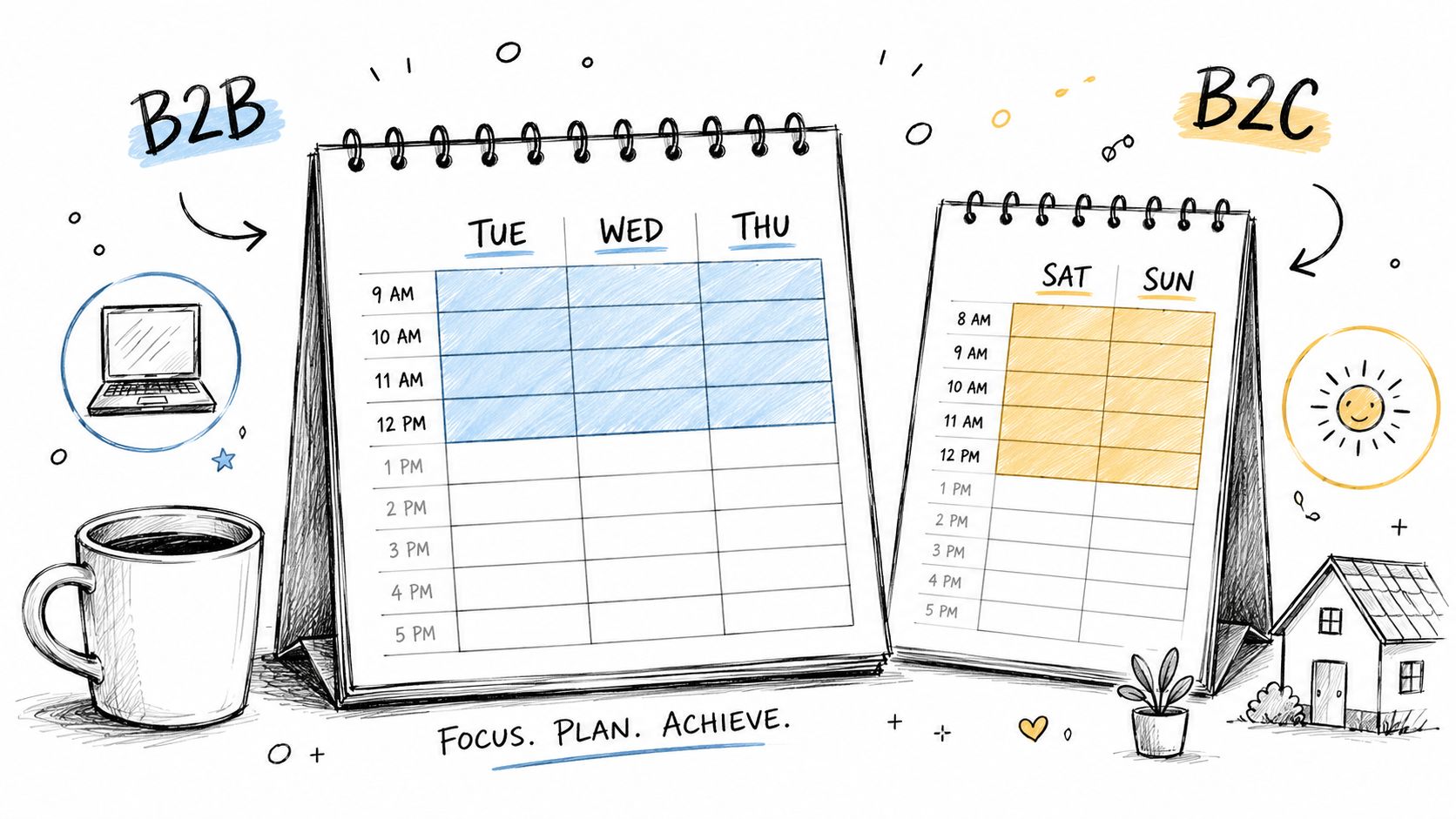
The default for most B2B newsletters is still Tuesday through Thursday, 9 AM to 12 PM local time. That window lines up with the strongest open patterns and avoids the Monday scramble, when many professionals are clearing the weekend backlog, and the Friday afternoon drift, when attention starts moving elsewhere. For firms that sell expertise, not impulse buys, the middle of the week is usually where inbox attention is most predictable.
B2B and professional services
For B2B, weekday mornings are the safest starting point. Professional services readers tend to be at desks, scanning inboxes, and prioritizing items that affect clients, compliance, budgets, or delivery. That makes the middle of the week a natural fit for newsletters that need to be opened, skimmed, and remembered.
Professional services firms should be especially cautious with Monday mornings. The week is just starting, calendars are already full, and many readers are triaging rather than exploring. Friday afternoons can also be a weak fit because attention shifts toward wrapping up and leaving work behind.
B2C and consumer-oriented lists
Consumer lists behave differently. Weekend mornings can outperform weekdays for some audiences, especially when the content is lighter, personal, or tied to leisure time. The broader point is that consumer readers often check email on a different rhythm than work-focused audiences, so the best time to send newsletters can move away from business hours.
That doesn't mean weekends are automatically better. It means the default needs to match the audience's life pattern. A retail-adjacent list, a lifestyle publication, or a creator-led newsletter may deserve a completely different timing strategy from a law firm or accounting practice.
Rule of thumb: use weekday mornings for work-driven lists, then test weekend or off-hours sends only when the audience's behavior justifies it.
The cleanest way to think about this is as a starting frame, not a rulebook. If your list behaves like a B2B audience, start in the workweek morning band. If it behaves more like a consumer audience, test outside the office day. The testing protocol later in the article is where that judgment gets verified.
Three Segmentation Levers That Override Generic Advice
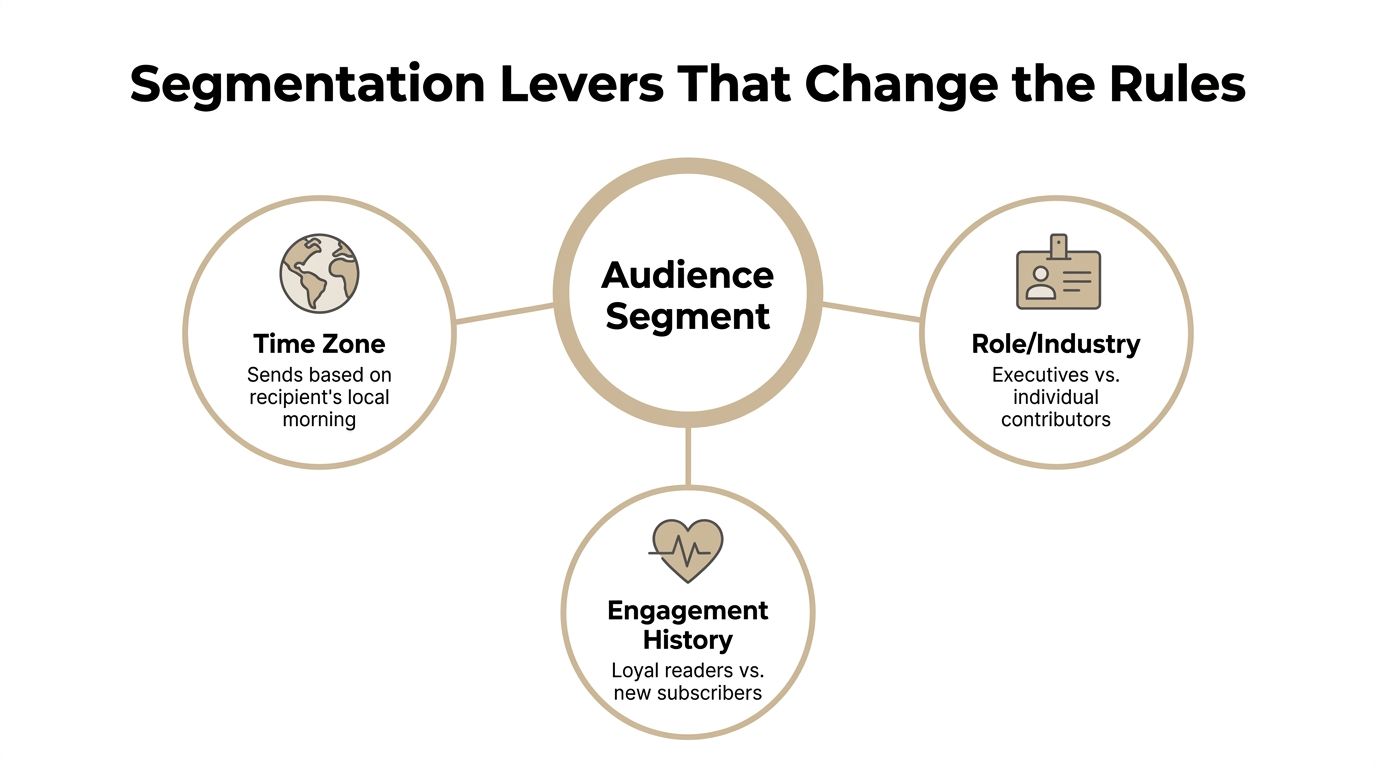
Generic timing advice breaks down fast when a list is mixed. A firm can have the right day and still send at the wrong hour for half the audience. The answer is to segment around the factors that change inbox behavior, starting with industry, role, and time zone.
Industry changes the rhythm
A financial advisory audience doesn't behave like an e-commerce audience. Workday-bound readers tend to check email in professional blocks, while personal-time readers are more likely to engage outside office hours. If the audience's industry is compliance-heavy, client-service-heavy, or operationally tied to the workday, a weekday morning default makes more sense.
The fix is simple. Weight the send time toward the dominant industry behavior instead of averaging every subscriber into one synthetic “best hour.” If one segment is clearly workday-centered, don't let a more casual segment distort the whole schedule.
Role changes the reading context
Executives and individual contributors don't live in the same inbox rhythm. Senior decision-makers often read when calendars briefly open up, sometimes early in the morning or later in the day. Operations and delivery teams are more likely to read during business hours, when email is part of the work rhythm.
Role-based segments let you match timing to decision style. A strategy note for partners may deserve a different send pattern than an operations update for staff. The newsletter itself can stay the same while the send time changes around it.
Time zone can quietly break a good schedule
A “10 AM Eastern” send is not a 10 AM send for the West Coast. It's a 7 AM arrival, which can erase the morning advantage for part of the list. That's one of the easiest ways to accidentally flatten performance while thinking the content is the problem.
The practical fix is to either stagger sends by recipient time zone or keep the list geographically constrained. If your audience spans multiple regions, local-time delivery is usually the cleaner answer. Newsletter strategy and segmentation guidance only work when the schedule reflects where the readers are.
An A/B Testing Protocol You Can Run This Quarter
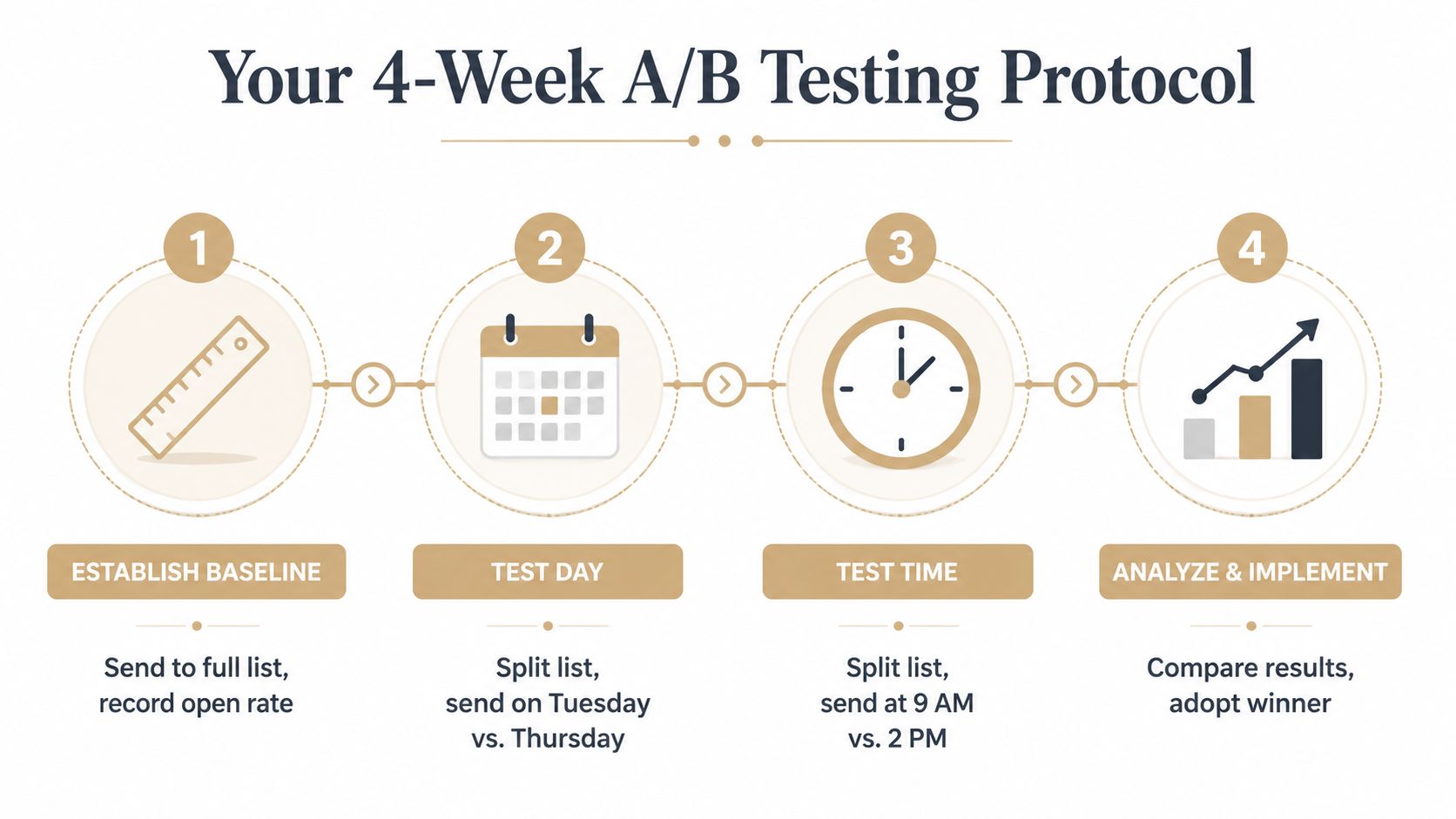
The easiest way to test send time is to change one variable at a time. If you test day and hour together, you won't know what caused the lift. If you test too many options at once, the result gets muddy fast. Keep the first test narrow, then build from there.
A practical four-week structure
Start with a baseline send on your current schedule. Then split the list and test either day or time, not both in the same experiment. A common first move is a Tuesday send against a Thursday send, or a 9 AM send against a 2 PM send, because those choices are easy to interpret.
Run the test long enough to avoid week-specific noise. A single strong or weak issue can mislead you, especially if the topic, subject line, or audience mood is unusual that week. A full month is a better minimum because it gives you several sends to compare instead of one noisy data point.
Practical rule: don't declare a winner from one send. Look for the same direction across multiple weeks.
What to measure and how to avoid self-deception
For timing tests, the metric should match the goal. If you care about visibility, look at opens as a directional signal. If you care about action, clicks are the more honest read, because opens can be affected by privacy changes and don't always reflect real engagement.
A useful way to think about sample size is simple. If your list is large enough that a meaningful lift would show up across 4 to 6 weeks, you can run a clean enough test to make a decision. If the list is too small, stick to the best-supported default and test less often.
ESP support varies, but the workflow itself doesn't. Some sending systems support send-time tests directly, while others require a manual split-send and a simple comparison afterward. Either way, the logic stays the same, baseline first, then one controlled variable, then a quarter of consistent observation.
Three Assumptions Worth Challenging
The first assumption is that 10 AM is universally best. It's not. It's the strongest default for broad B2B visibility, but list-specific factors can matter more than a narrow hour difference. If the audience is split by role or geography, the “average” can hide the actual behavior.
The second assumption is that weekends are dead. They're often weak for B2B, but that doesn't make them useless. Consumer lists, creator-style lists, and lifestyle-heavy content can behave very differently, and most firms never test weekends long enough to know whether they're leaving engagement on the table.
The third assumption is that open rate is the main metric that matters. That's risky, because open behavior has been distorted since Apple Mail Privacy Protection changed how opens are recorded. If a newsletter's purpose is action, then a send time that inflates opens but suppresses clicks may look good in the dashboard and still underperform in the business.
For that reason, timing decisions should also be checked against deliverability context. If a newsletter isn't reaching the primary inbox, send time won't rescue it. Primary tab placement context matters because the best schedule in the world won't fix poor inbox placement.
The better questions are more practical. Who's receiving the email, when do they read it, and what do you want them to do next? Those questions lead to a better decision than copying a benchmark without context.
Your Default-and-Test Framework
The default for a B2B professional services newsletter is Tuesday, Wednesday, or Thursday at 9 AM to 10 AM in the recipient's local time zone. If the job is visibility, that's the safest evidence-backed starting point. If the job is action, test a later send window, because clicks often peak after the morning open spike.
Segment by industry, role, and time zone when the list is mixed enough to make averages misleading. Keep weekdays for work-driven audiences, and only lean into weekends or off-hours when the reader's behavior supports it. That's how you move from generic advice to a schedule that fits the audience.
Use one variable per quarter, run the test for at least a month, and look for the same direction across multiple sends. Ignore out-of-date case studies that predate privacy changes, benchmarks that blend heavy B2C and B2B audiences, and “best day” memes that don't say who the list is for. A clean schedule beats a clever one if your team can't sustain it.
If your firm is sending a weekly newsletter on a fixed cadence, the right send time is the one your team can hit every week at the same hour, because consistency compounds. If you want that cadence planned, written, and shipped without the usual scramble, NewsletterAsAService can help you build the weekly system around it.
Done-For-You
We write the newsletter. You stay in front of your clients.
One flat rate at $399/mo. Research, writing, and formatting handled for you, in your voice. First edition free.
Get a Free SampleRelated