
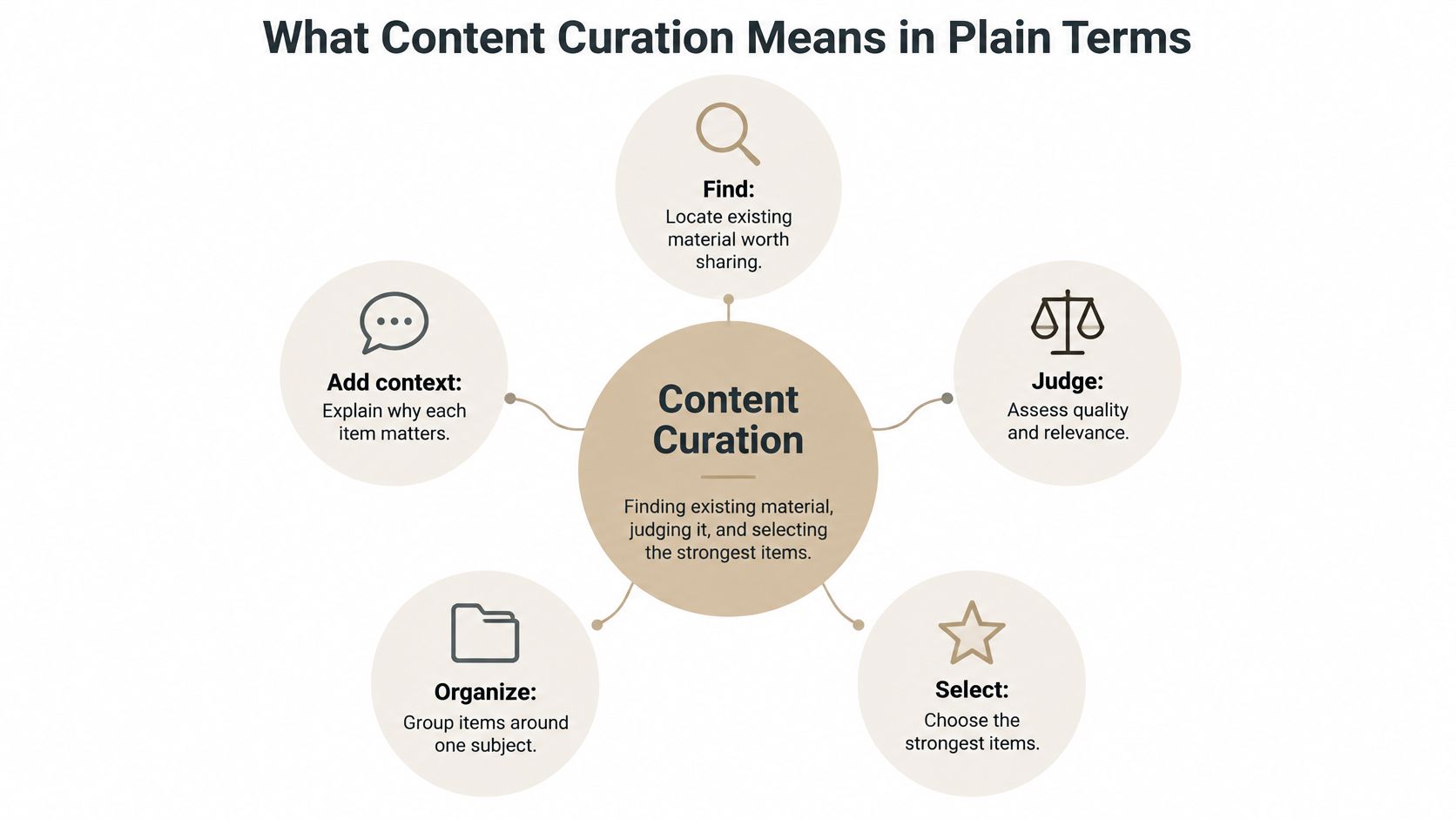
Content curation is finding existing material, judging its quality, selecting the strongest items, and explaining them for a defined audience.
Your newsletter is due, your inbox is full of industry updates, and several articles seem worth sharing. But one summarizes an old rule, another applies somewhere your clients don't operate, and a third makes a proposal sound final. Choosing links is easy. Knowing which ones deserve a reader's attention takes editorial judgment.
For a regulated firm, that judgment should be inspectable. Every selection needs an original source, a publication date, a jurisdiction, and a stated reason for inclusion.
Table of Contents
- What Content Curation Means in Plain Terms
- Curation Compared With Creation and Aggregation
- Source Types Ranked for Regulated Industries
- Running the Seven-Step Curation Workflow
- Building an Audit Trail for Every Selection
- Tools That Cover Each Stage of Curation
- Where Curation Goes Wrong and Where AI Fits
What Content Curation Means in Plain Terms
A museum curator doesn't paint the works on display. They choose the pieces, arrange them, and write labels that help visitors understand their significance. A content curator does a similar job with information.
A weekly industry roundup, a saved-article feed shared with a team, and a themed reading list can all be curated. The format isn't what makes them useful. The decisions behind them are.
The Oxford Handbook chapter on curation describes the practice as the “discriminate selection and organization” of materials. That distinction matters: gathering information is only the beginning.
The tests that separate curation from sharing
- Judgment: Someone decided why this item matters more than the alternatives.
- Audience fit: The explanation addresses a particular reader's questions, responsibilities, or decisions.
- Traceability: The original source remains visible so the reader can inspect the claim.
Forwarding an article with an enthusiastic endorsement doesn't meet those tests. Explaining that an agency notice affects employers operating in a particular state, while identifying the relevant exception, does.
The process is easier to recognize when its editorial decisions are visible.
What the curator actually produces
In professional publishing, the curator searches open sources, verifies claims, groups the selected material, and presents it in a useful format. The result might be a newsletter organized around payroll obligations rather than a chronological list of everything published about accounting.
That organization is part of the value. Readers shouldn't have to work out whether an item is background reading, an approaching obligation, or something requiring immediate attention.
Good curation removes unnecessary searching without removing the reader's route to the evidence.
The practical answer to “what is content curation?” is therefore broader than sharing other people's work. It's making an informed selection and helping a specific audience understand it.
Curation Compared With Creation and Aggregation
| Activity | Starting material | What the audience gets | Main risk |
|---|---|---|---|
| Content creation | Original research, reporting, or client experience | Original analysis and a distinct voice | Highest time cost per item |
| Content curation | Published sources checked against originals | A shorter path to what matters, with reasons | Thin summaries that drop context |
| Content aggregation | Automated feeds and keyword alerts | Breadth and volume | Duplicates and no editorial judgment |
| Digital preservation, for contrast | Files and records to store | Long-term access to assets | Not built for audience selection |
The useful question is: Did someone decide what matters and explain why? Aggregation retrieves matches. Curation evaluates them. Creation contributes original reporting, insight, or expression.
These activities can support each other. An automated feed can supply candidates for a curated edition, while the firm's own analysis explains what a selected development means for its clients. Saving the underlying documents supports preservation, but storage alone doesn't produce an editorial selection.
Why selection became a distinct practice
An academic review of content-curation literature traces the modern field to Rohit Bhargava's 2009 The Manifesto for the Content Curator and reports that a 2024 review of Scopus-indexed research found 88 occurrences of the keyword “content curation.” The underlying problem was abundant material and scarce attention.
For a marketer, that history explains why curation isn't merely a cheaper substitute for writing. Finding material is easy; rejecting unsuitable material and connecting the useful pieces requires subject knowledge.
A newsletter can legitimately mix original and curated content. Label the distinction clearly: identify the outside publisher, summarize its contribution, and separate your firm's interpretation from the source's actual statement. Readers shouldn't have to guess who made a claim.
Source Types Ranked for Regulated Industries
Start with binding primary authority. Use commentary to locate and understand the original, not to replace it.
Authority isn't a property of a publisher's name alone. An official body can publish a binding rule, a consultation, an explanatory page, or a nonbinding announcement. The curator must identify the document type before describing its effect.
| Source type | Examples | Binding or advisory | Use it for |
|---|---|---|---|
| Regulators | Securities, tax, insurance, and licensing authorities | Rules and enforceable requirements within their remit; other publications may be advisory | Rule changes, deadlines, and enforcement actions |
| Courts | Federal and state court opinions | Binding effect follows jurisdiction, hierarchy, and precedential status | Rulings affecting how a practice operates |
| Standard-setters | Accounting and cybersecurity standards bodies | Required when adopted by applicable rules, contracts, or professional obligations | Accounting, security, and reporting standards |
| Trade associations | Professional accounting, legal, and industry associations | Generally advisory; distinguish separate professional requirements | Practice guidance and professional development |
| Industry journals | Trade and professional journals | Advisory analysis | Context, trends, and interpretation |
| Vendor and consultant blogs | Commercial publishers and commentators | Commentary; quoting authority doesn't make the post binding | Pointers to primary documents |
Read authority at the document level
A tax agency notice and a blog summarizing it may describe the same filing change. The blog can help you discover the issue, but the notice establishes the actual terms. If their descriptions differ, don't average them or choose the clearer wording. Resolve the discrepancy against the official document.
Court opinions need similar care. A striking passage may not be the court's holding, and a decision from another jurisdiction may be informative without controlling your reader's situation.
Standards require an adoption check. A newly published standard isn't automatically mandatory for every organization. Find the rule, agreement, or professional requirement that makes it applicable.
Checks before accepting a source
- Publisher identity: Confirm who issued the material and whether the page is authentic.
- Original availability: Open the underlying notice, judgment, standard, or publication.
- Document currency: Check the publication date, amendments, corrections, and replacement notices.
- Jurisdiction match: Confirm that the affected location and regulated activity match the audience.
Trade guidance and journal analysis are useful for explaining operational consequences. Keep their interpretations distinct from the underlying obligation, especially when reasonable specialists disagree.
Editorial safeguard: A recent article can summarize an obsolete rule. Check the status of the original, not just the date of the commentary.
Before publishing, look for superseding material on the issuing body's website. If you can't establish the document's current status, hold the item or state the unresolved limitation explicitly.
Running the Seven-Step Curation Workflow
Say a CPA firm is preparing a weekly edition for employers. A state tax agency publishes a notice moving a payroll filing deadline. The editorial task is to determine which clients are affected, what the notice actually changes, and what readers should check.
The City University study of personal curatorial strategy examines selection and sequencing as responses to information overload. For a professional newsletter, a repeatable procedure turns that selection into a controlled publishing process.
Use the following weekly sequence as a starting routine, adapting the schedule to your approval requirements.
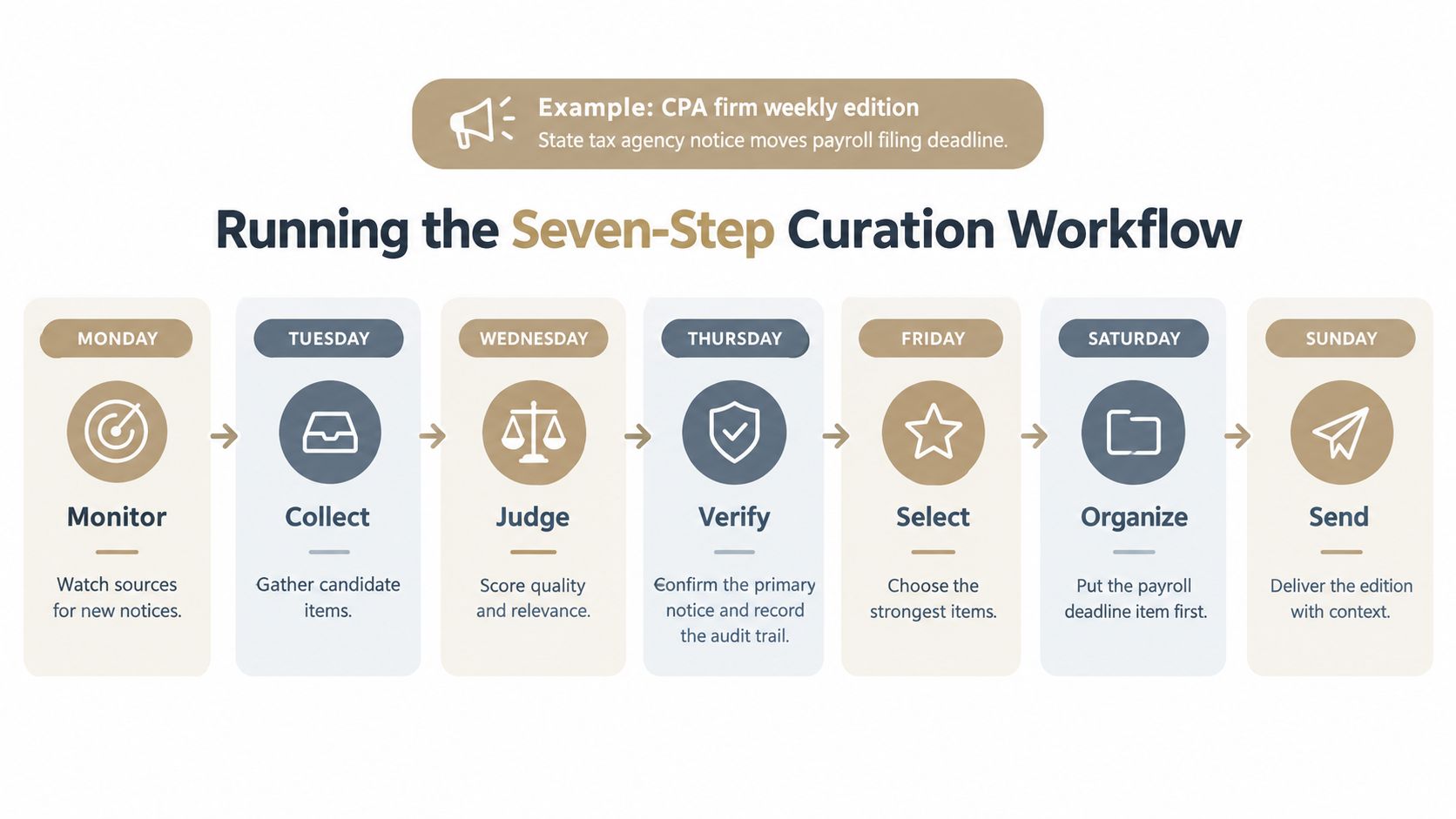
Establish the brief and gather candidates
Day one: Define the audience and scope.
Name the clients, jurisdictions, and decisions the edition serves. For the hypothetical CPA firm, the brief might cover payroll administrators at employers operating in the firm's home state, with an emphasis on filing obligations and practical checks.Build a short source register ranked by authority. Record the relevant agency notice pages, official bulletins, and specialist publications.
Checkpoint: Another editor can tell what belongs in the edition and what doesn't.Day two: Monitor the named sources.
Review the register rather than browsing an unrestricted news feed. Capture candidate titles, original addresses, publication dates, and a brief note about possible relevance.When commentary flags the payroll change, follow its reference to the agency notice before promoting the item into the working list.
Checkpoint: Every candidate has a retrievable original or is marked as awaiting verification.Day three: Screen and verify the candidates.
Open the payroll notice and distinguish its publication date from its effective date. Check which employers, filing periods, and obligations it covers.Look for exclusions and conditions. A filing extension may not change a payment obligation, so don't assume that related deadlines moved together. Log screened and rejected items, including the reason for rejection.
Checkpoint: The candidate's scope and legal status are clear enough to assess.
Make and test the editorial decision
Day four: Rank and select.
Assess relevance, credibility, novelty, and actionability. Use a consistent scoring scale if it helps editors compare candidates, but write a reason alongside the score.The payroll notice deserves prominence if affected readers need to change an upcoming process. Repeated summaries of that notice don't deserve separate places merely because different publishers covered it.
Checkpoint: Each selected item contributes something distinct.Day five: Write the reader takeaway.
Explain what changed, then identify what the reader should check. For this scenario, the takeaway might say that the agency moved the filing deadline for covered employers and that payroll administrators should confirm their filing calendar reflects the notice.Insert the actual verified dates and original document link during production. Don't fill missing details from memory, and don't expand the extension beyond the notice's scope.
Checkpoint: The wording separates the official change from the firm's practical recommendation.Day six: Conduct independent review.
Have another qualified reviewer compare every factual claim with the original. Ask them to inspect exceptions, affected periods, and terms that carry legal significance.Words such as must, may, proposed, and effective aren't interchangeable. A readable sentence still fails review if it changes the obligation.
Checkpoint: The reviewer approves the specific wording, not merely the topic.Day seven: Publish and record.
Put the item where its operational importance warrants, test its document link, and classify it by jurisdiction, effective date, affected audience, and required action. Retain the approved version and record subsequent corrections.
If a mistake changes what readers should do, send a correction through the channel that reached them. Editing an archive without notice may leave the original misunderstanding intact. Checkpoint: A colleague can reconstruct what was published and why.
Evaluate the routine
Track selection ratio, calculated as selected items divided by screened items, alongside factual errors and corrections. A lower ratio isn't automatically better: an edition can be narrow and still miss the development readers needed most.
Also review clicks through to originals. Those clicks can indicate that readers are checking details, but they don't prove that every recommendation was understood. Read replies and recurring questions alongside them.
Document ownership, handoffs, and approval gates in an editorial process. If the work doesn't fit your internal capacity, compare recorded production time and rework with a managed editorial option. Keep responsibility for specialized approval explicit in either arrangement.
Building an Audit Trail for Every Selection
A short summary can remove the exception that changes a document's meaning. When the remaining sentence sounds confident, readers may act with more certainty than the source justifies.
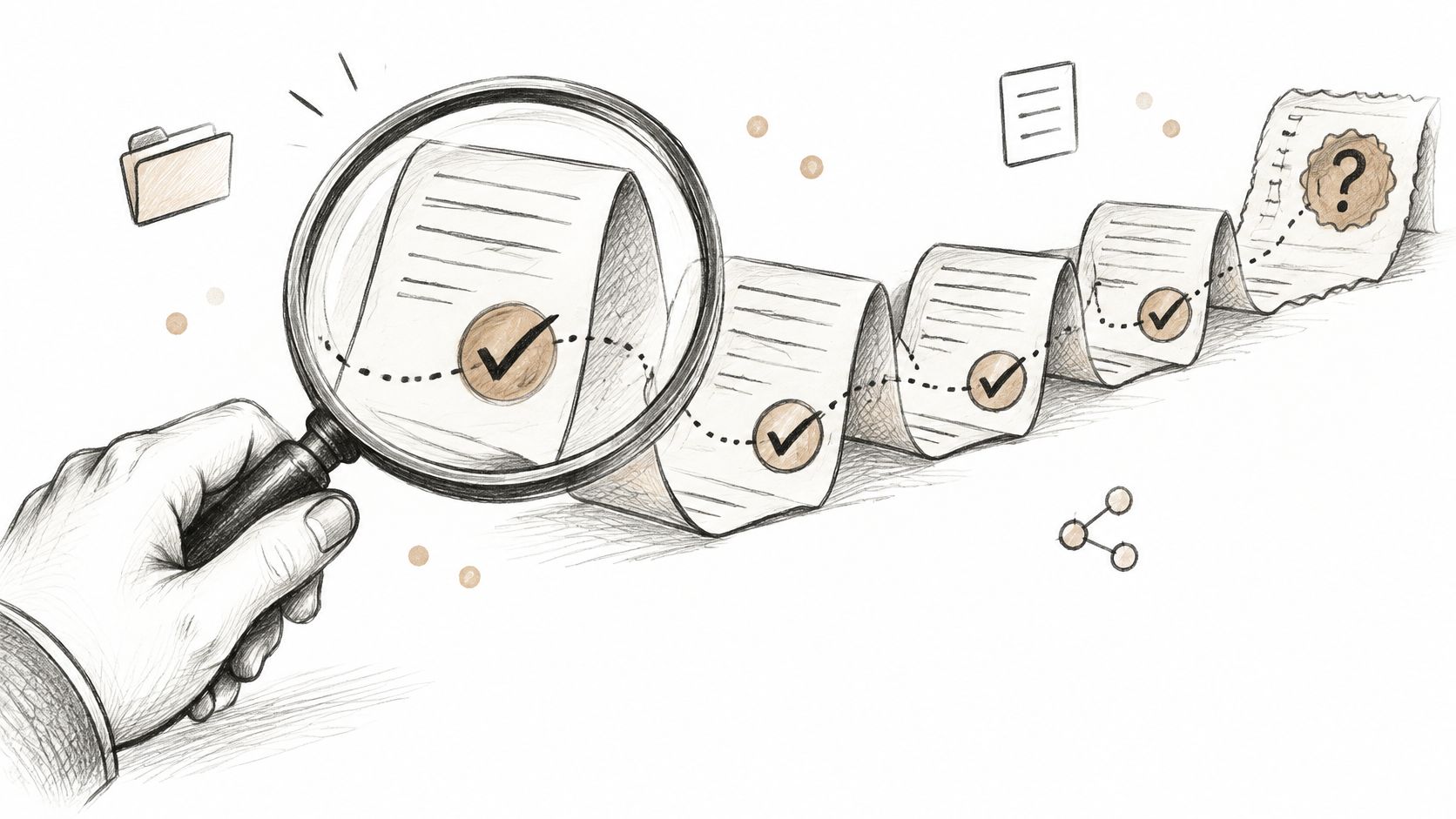
The safeguard is a source log that makes the editorial decision inspectable. Review should cover both the wording and the evidence behind it.
| Field | What to record | Payroll notice example |
|---|---|---|
| Source link | Address of the original document | Official state agency notice page |
| Publisher | Body that issued the document | State tax agency |
| Original publication date | Date printed on the notice | Date on the notice |
| Jurisdiction | Where the rule applies | Named state |
| Binding or advisory | Legal status of the document | Binding, confirmed for this scenario |
| What changed | One-sentence statement | Payroll filing deadline moved |
| Verifier and check date | Reviewer name and date of check | Assigned reviewer and recorded check date |
| Correction | Later fixes and their dates | None yet |
For the hypothetical payroll notice, the completed record would connect the official page to the issuing agency, transcribe the actual publication date and state, and identify the covered filing obligation. It would also name the reviewer, record when verification occurred, and retain any subsequent correction. Add a reason for inclusion: affected employers need to update their filing calendar.
Make the evidence easy to inspect
A study of major newspaper newsletters found that 96.7% of curated items came from websites, while identifying reliable external links and contextual explanation as sources of newsletter value and credibility. That finding concerns newspaper newsletters, but it reinforces a practical editorial distinction: accessible references and explanation belong together.
A compact edition with complete records can be more useful than a crowded roundup whose claims are difficult to check. The advantage isn't brevity alone; it's reduced uncertainty.
Use this companion video alongside your review checklist.
Assign escalation and sign-off responsibilities through a documented compliance review process. On a monthly maintenance pass, reopen logged sources, mark superseded guidance, and flag archived summaries that need an update.
Tools That Cover Each Stage of Curation
| Stage | Tool type | Practical implementation | Watch out for |
|---|---|---|---|
| Monitor | RSS reader | Folders grouped by authority and subject | Covers only sources that publish feeds |
| Monitor | Keyword alerts | Narrow queries for relevant agencies and obligations | Heavy duplication from syndicated copies |
| Organize | Spreadsheet or database | Shared source log with fixed fields | Inconsistent entries make review difficult |
| Draft | AI summarizer | First-pass outline from a supplied original | Every claim needs comparison with the document |
| Publish | Email service provider | Approved template and test send | Broken or misdirected links |
| Share | Social scheduler | Queue of approved excerpts | Automatic posting can omit necessary qualifications |
Tools find and organize candidates; people decide what belongs. Choose software around the editorial handoffs rather than building a collection of overlapping features.
For monitoring, combine feeds with direct checks of important pages that don't offer them. Narrow alert queries to the agencies, subjects, and document types you cover. Otherwise, syndicated copies can make an old development look like a fresh cluster of news.
Keep the source attached throughout production
Build the organizing system around fixed fields and controlled status labels, such as awaiting verification, approved, and rejected. Store the inclusion reason beside the original document address so drafting doesn't separate the claim from its evidence.
The working setup should show where an item stands and who owns its next review.
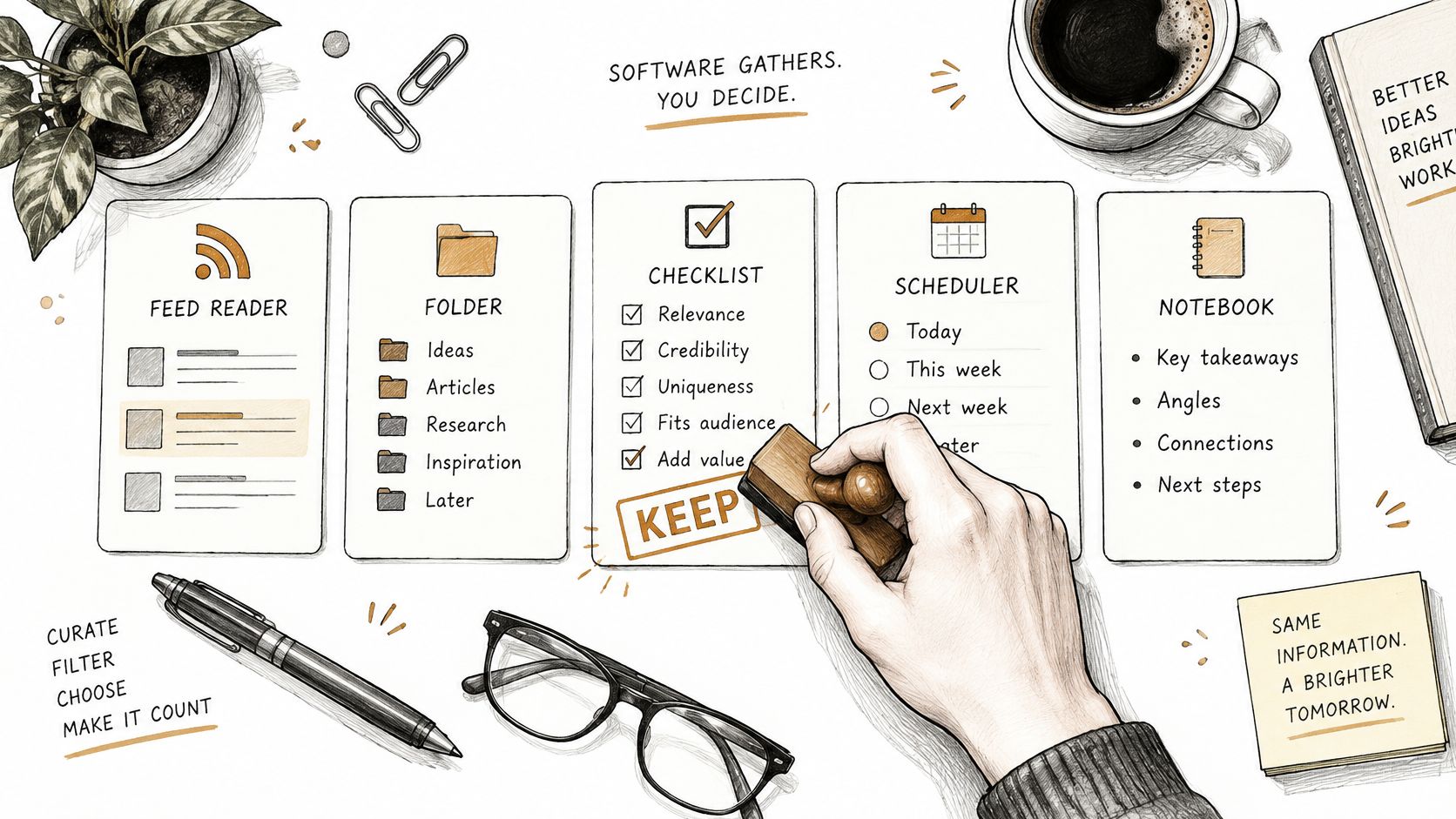
During drafting, compare generated summaries line by line with the source. At publication, test links in the actual email preview, including links hidden behind buttons or images.
Social excerpts need their own approval because shortening can remove a limitation. Don't schedule a broad claim if the newsletter version was accurate only because it included a jurisdiction or exception.
Choose ownership before adding software
An internal editor can operate this system with a reader, a shared log, and an email platform. A managed editorial service is another arrangement when the firm lacks production capacity, provided source records and approval responsibilities remain accessible.
Use a documented source-monitoring stack to show which tools support each stage. Keep a tool only if it reduces searching or handling without losing the original evidence or the reason an item was selected.
Where Curation Goes Wrong and Where AI Fits
The most common misconception is that curation means forwarding links. Automation makes that mistake easier to repeat, not more defensible.
- Copying links is enough: A reader still needs to know why the item deserves attention.
- More items mean more value: Extra material can bury the development that requires action.
- A summary replaces the source: A condensed account can't carry every qualification.
- Automation can own the process: Someone must remain accountable for unresolved conflicts and published wording.
Divide the work by responsibility
AI can assist with broad discovery, deduplication, tagging, and draft summaries. The accountable editor retains source selection, conflict resolution, interpretation, attribution, and final fact-checking.
Discovery deserves particular caution. A 2025 study discussed in this article on AI and curation found that 60.0% of reputable sites blocked at least one AI crawler, compared with 9.1% of misinformation sites; separate experimental work described there found stronger user interaction for AI-generated social content with human refinement than for a fully automated workflow.
Crawler restrictions can make authoritative material harder for automated systems to access. They don't prove that a particular generated answer is wrong, but they're a reason not to treat automated discovery as a complete source universe.
The division of work should remain visible to the editor.

Accountability test: If the assistant can't produce the original document behind a claim, don't approve that claim for publication.
The workable model is provenance-aware hybrid curation: automated assistance under human editorial control. Every summarized claim remains connected to an identifiable regulator, association, court, standard-setter, or research publication, and an editor takes responsibility for what readers are told.
NewsletterAsAService plans, writes, designs, and sends weekly B2B newsletters for professional-services firms, using primary industry sources and the client's voice. If you need a managed routine for turning industry developments into source-linked editions, visit NewsletterAsAService to explore the service and its approval workflow.
Done-For-You
We write the newsletter. You stay in front of your clients.
Two editions per month at $750/mo. Research, writing, and formatting handled for you, in your voice. Start with one edition for $500.
Order a $500 EditionRelated