
You're probably sitting on the same problem most professional services firms hit at some point. The email subscribe list is growing, but the people on it aren't all equally useful, and every new signup feels like a small win until the first send tells the truth. A bigger list can look impressive while dragging down open rates, deliverability, and morale.
The right move is not “grow at all costs.” It's choosing the kind of list you want, building it with intention, and accepting the friction that protects quality. Email still matters because it's one of the highest-ROI digital channels, with industry summaries putting returns at about $36 to $42 for every $1 spent on average, and global usage is still massive, at an estimated 4.6 billion email users in 2025 and 376.4 billion messages per day (Oberlo email marketing statistics). That scale is exactly why subscriber quality matters so much.
Where this fits in a working newsletter programme: See the newsletter strategy playbook, the detail on newsletter cadence for accounting firms, or ask for newsletter service pricing.
The Quality Versus Quantity Decision Every List Builder Faces
The first decision is clear. Do you want a big list, or do you want a list that earns its keep? Professional services firms get tripped up here because vanity counts are easy to report, while list quality only shows up when people open, click, reply, and book.
Pick the audience before you pick the form
Start by naming the subscribers that matter most. For a firm, that might mean referral partners, existing clients, in-house contacts at target accounts, or niche prospects who already care about a specific regulatory or commercial issue. Once that profile is clear, the rest of the system becomes easier, because the sign-up form, lead magnet, and cadence can all filter for that audience instead of collecting everybody with a pulse.
Practical rule: if you can't describe the ideal subscriber in one sentence, your list-building plan is too broad.
There are three operating modes, and the right one depends on your business model. High-volume acquisition fits broad consumer-style offers or firms with huge top-of-funnel traffic. Curated growth fits most professional services teams, because it balances reach with relevance. Closed-beta style works when the audience is narrow, the subject matter is specialized, or the list is meant to support account-based relationships rather than mass marketing.
The wrong choice creates predictable problems. If you choose high-volume tactics but your service is specialized, you'll attract readers who never buy and won't stay engaged. If you choose closed-beta discipline when you need reach, you'll underfill the pipeline and overvalue polish. For a quick way to sanity-check the tradeoff, use an internal ROI lens like the newsletter ROI calculator, then ask whether the list you're building can support the kind of revenue you want.
The clean takeaway is simple. Choose the audience first, then decide how much friction protects that audience. Everything else in the system flows from that choice.
Lead Magnits That Pull In the Right Subscribers
A lead magnet should not be a generic giveaway. It should solve one narrow problem for the exact person you want on the list, and it should do it quickly. In professional services, the offers that work best are usually the ones that save time, reduce uncertainty, or help someone decide what to do next.
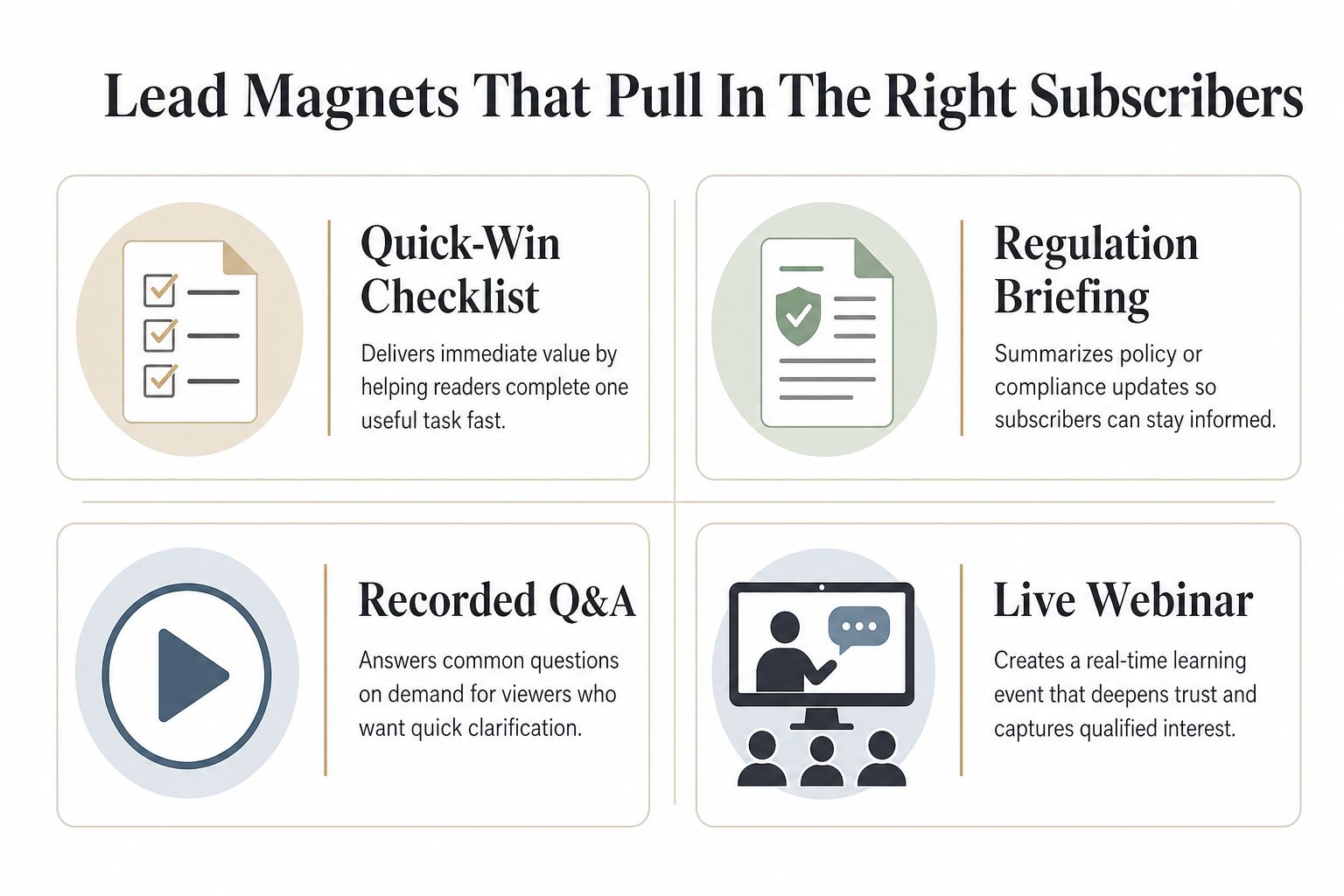
Four formats that actually earn attention
A single-page checklist works when the reader already knows the task and just needs a clean path through it. A tax firm might offer a year-end filing checklist. A law practice might offer a due-diligence intake checklist. These convert well when the reader wants something practical and fast, not another long document to bookmark and forget.
A short regulation or tax-update briefing is stronger when the audience is scanning for implications, not education. A one-page briefing on a new filing rule, a changing deadline, or a narrow compliance issue tends to attract serious readers because it signals relevance. Long PDFs usually underperform here because busy professionals don't want to spend twenty minutes figuring out whether the content is worth the download.
A recorded Q&A or webinar replay works best when the topic has judgment calls, not just facts. A firm can use a replay to answer common client questions after a policy shift, a pricing change, or a planning deadline. The upside is trust, because the format shows how people think in real time. The downside is that it can attract tire-kickers if the topic is too broad.
A diagnostic or assessment tool is the most selective format of the four. A financial firm might offer a readiness assessment or a planning scorecard. This format tends to pull in better-fit subscribers because people self-identify by how they answer the questions. It's less flashy than a giveaway, but it's often more useful.
The rule of thumb is straightforward. The lead magnet should answer one question your ideal client is already Googling. Request a sample newsletter experience only if you want a sense of how a subscription offer can be framed around that kind of specificity.
Designing a Signup Flow That Does Not Leak Conversions
A working signup flow has four pieces, and each one shapes list quality. The form collects the address. The confirmation step checks intent. The welcome sequence sets expectations. The tagging layer makes the rest of the system usable.
Build the flow in the right order
Start with the form, and keep it easy to finish without hesitation. It should still tell people what they are getting. Embedded forms fit content that already has attention, while modal and slide-in formats can work on high-intent pages if they appear at the right moment. Dedicated landing pages fit offers that need more explanation, because they remove distraction and make the exchange explicit.
Double opt-in adds friction, and that friction usually improves list quality and protects deliverability. Single opt-in can work in some B2B settings where the audience is already warm and the acquisition source is tightly controlled, but it is a weaker default if you care about invalid addresses or careless signups. The safer pattern is clear consent, then confirmation, then a short welcome sequence that starts teaching the relationship immediately.
Keep the welcome sequence short, direct, and useful. New subscribers are paying more attention there than they will a month later.
The welcome sequence usually needs to do three jobs. It should confirm the promise that brought the person in. It should establish cadence so the inbox does not become a surprise. It should point toward the next useful action, whether that is reading a key article, updating preferences, or replying with a question. That is also the right place to introduce source tagging, because source data only matters if it survives the handoff from the form to the list.
| Signup Flow Components and What Each One Owns | ||
|---|---|---|
| Component | Primary Job | Quality Lever |
| Opt-in form | Collect the address and set expectations | Clear offer and low confusion |
| Confirmation email | Verify intent before activation | Reduces bad signups |
| Welcome sequence | Build early engagement | Reinforces relevance |
| Source tagging | Preserve acquisition context | Supports better segmentation |
The easiest way to lose conversions is to add trust-breaking friction. Pre-checked boxes, hidden unsubscribe paths, and vague language all make the list harder to manage later. Replace them with plain consent copy, visible choices, and a clean unsubscribe link in every send. If your current workflow is messy, a the newsletter content compliance review process is a better starting point than another round of form redesign.
Segmenting at Signup Instead of After
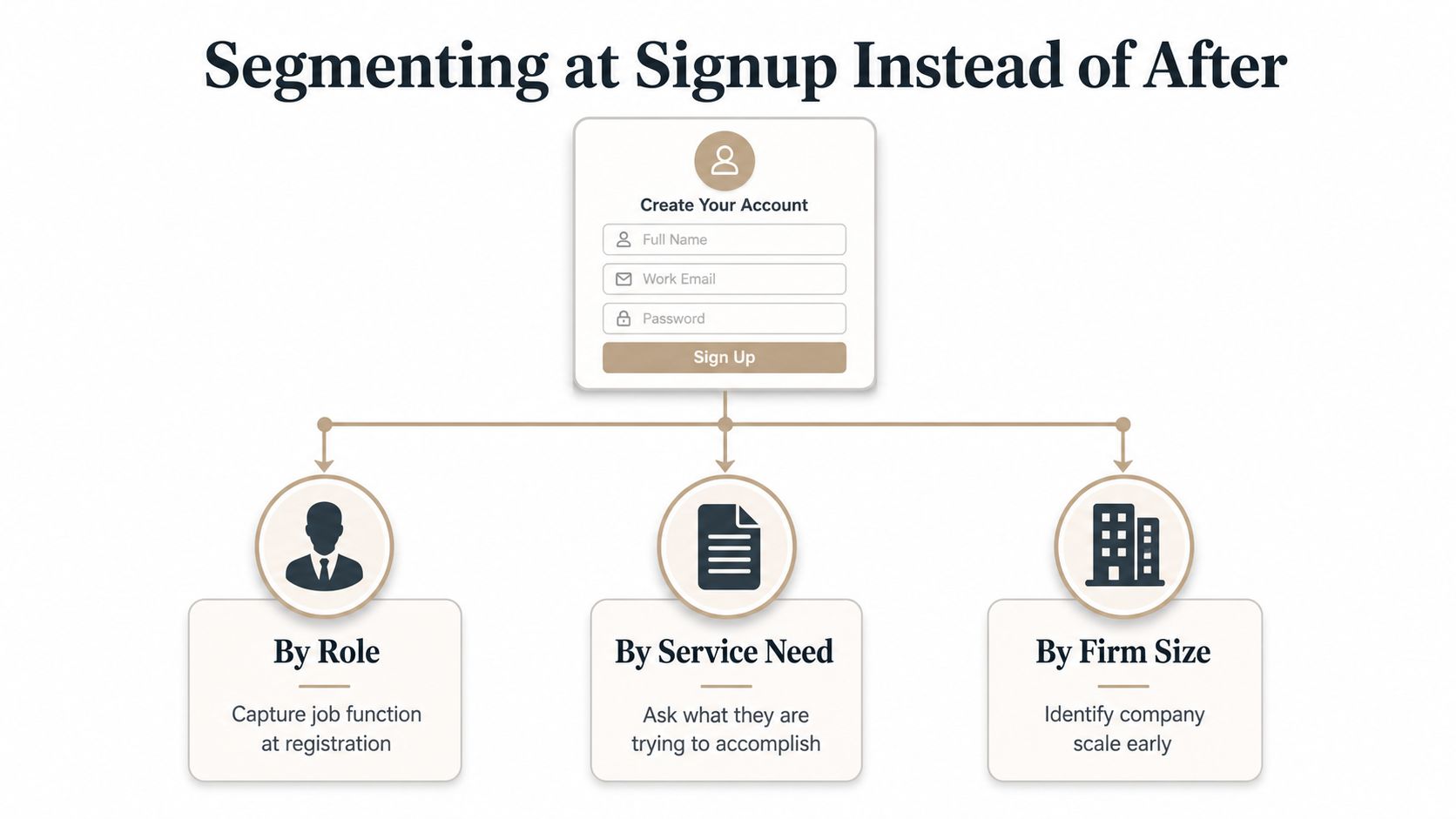
Segmentation works best when it starts at the point of opt-in, not after a few messy sends. By the time someone has been dropped into a generic automation and ignored for weeks, you've already lost the chance to match their expectations. A clean signup flow asks for just enough information to route the subscriber correctly from day one.
Use three dimensions that matter in professional services
The first dimension is role. A client, a prospect, and a referral partner don't need the same content or cadence. The second is topic interest, which usually shows up as a choice between regulatory updates, planning guidance, or industry commentary. The third is frequency preference, because some subscribers want every update while others only want a monthly briefing.
These can all be captured without wrecking conversion. A one-step form can use simple checkboxes, while a two-step form can ask for the email first and the preferences second. That second step feels lighter because the subscriber has already made the decision to engage, and the extra fields now feel like tailoring instead of interrogation.
A financial advisor firm is a good example. Someone who wants regulatory updates can be routed into a more alert-driven cadence, while general education readers can get a slower, broader stream. The point isn't to create endless microsegments. It's to avoid forcing every subscriber into the same rhythm, then wondering why open rates flatten out.
Here's the useful mindset shift. Don't treat preference capture as a back-office cleanup task. Treat it as part of the offer itself. If your list promises relevance, then the signup form has to ask for the inputs that make relevance possible.
GDPR and CAN-SPAM Without the Legalese
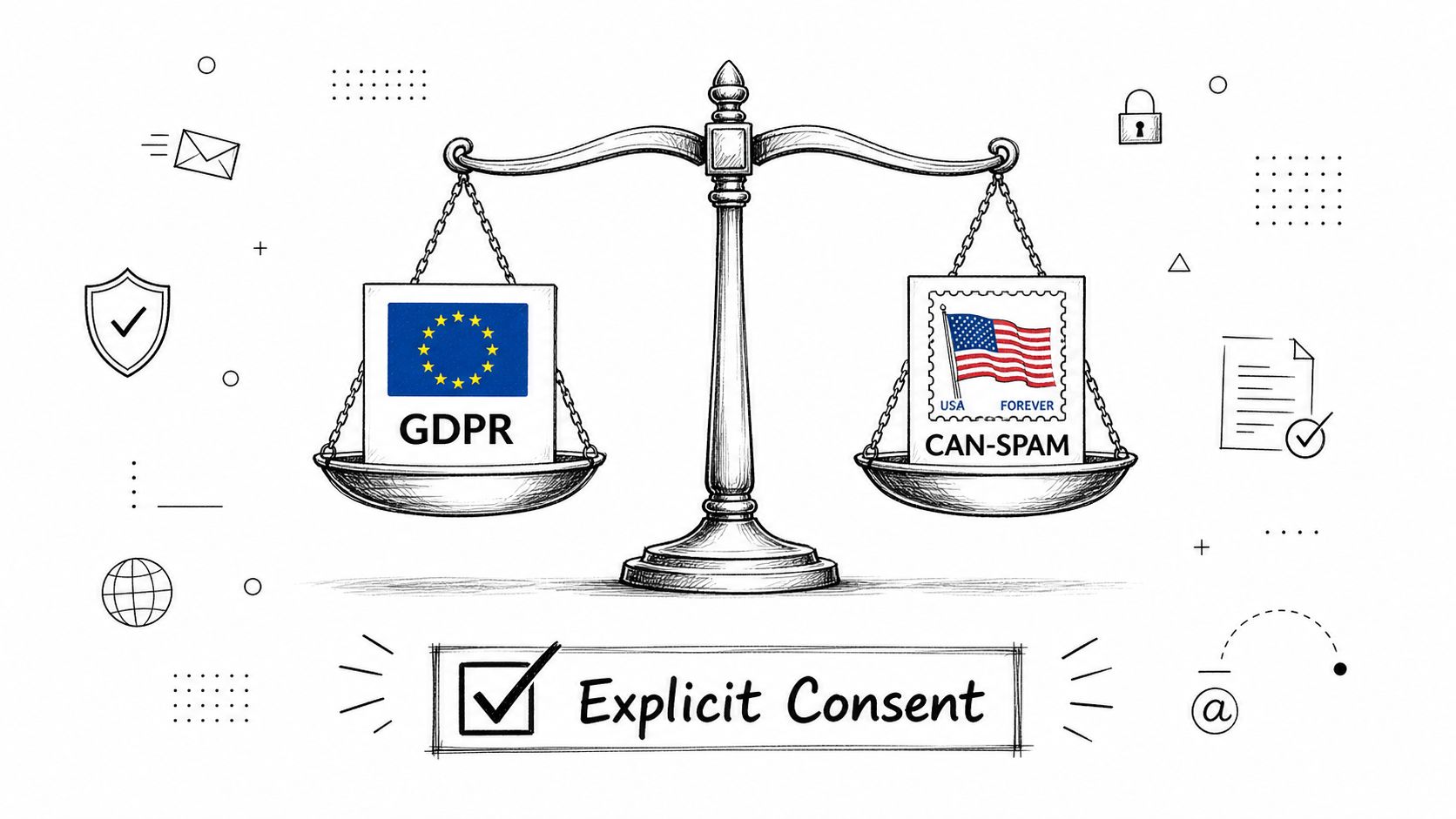
A signup form for an email subscribe list needs to do two jobs at once. It has to collect the address, and it has to set the compliance terms clearly enough that nobody is guessing later. In the EU, GDPR puts explicit consent and the right to withdraw at the center of marketing email. In the U.S., CAN-SPAM requires sender identification, a physical address, and a working unsubscribe mechanism in every message. Professional services firms that mail across jurisdictions, or collect subscribers from mixed sources, need to meet both sets of expectations in practice.
Build for consent, not just collection
A common mistake is treating B2B status as a shortcut around the rules. It is not. In the EU, legitimate interest has narrow use for marketing email, so explicit consent is usually the safer default when the message is promotional. The form should state what the subscriber is signing up for, who is sending it, and how they can leave if it stops being useful.
There are four fields or disclosures every form should cover. Consent language tells the subscriber what they are agreeing to. Sender identification tells them who owns the list. Content description tells them what they will receive. Unsubscribe access belongs in every send, not hidden behind support tickets or secondary pages.
The operational mistake is treating compliance as a one-time legal review. It is ongoing work. Consent records, retention discipline, and unsubscribe handling all shape whether the list stays usable over time. Teams that skip this work usually end up with bloated lists, vague records, and a cleanup problem later.
If a subscriber cannot tell who you are, why you are emailing, and how to opt out, the signup flow is not finished.
That is why the simplest compliant form is often the strongest one. It is explicit, easy to explain, and easier to maintain when the list grows. If the current process needs a practical audit, start with our newsletter content compliance review process and fix the wording before you chase more signups.
Measuring Net List Growth Instead of Subscriber Count
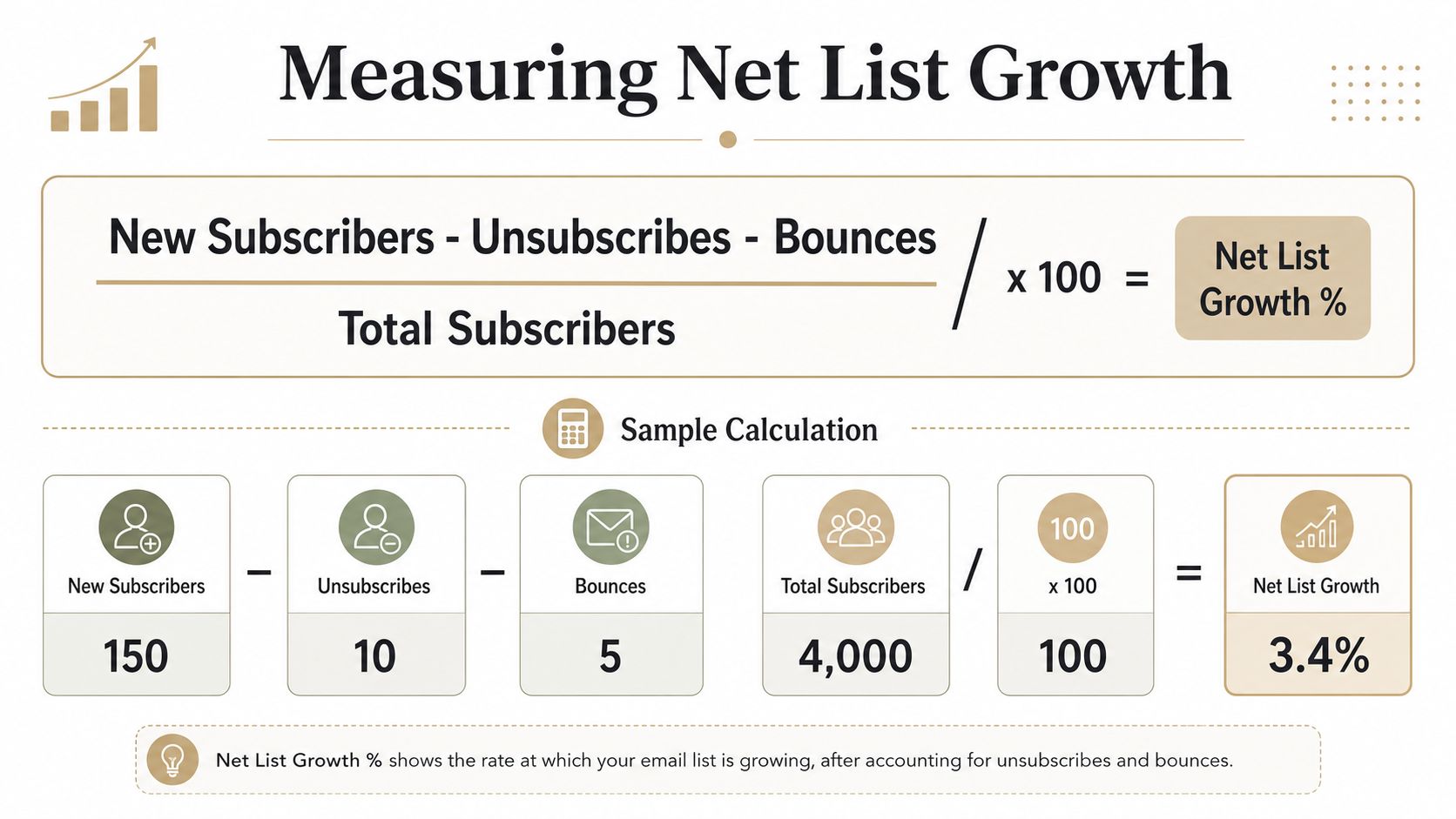
Raw subscriber count is a lazy headline. It can rise while the program gets worse, because people unsubscribe, addresses bounce, and inactive readers stop behaving like an asset. Net list growth is the better metric because it tells you whether the list is expanding after losses are included.
Read the number that exposes decay
The basic formula is (new subscribers − unsubscribes − bounces) ÷ total subscribers × 100. That's the only figure that matters if you want a realistic view of list momentum. A growing count with a weak net rate often means acquisition is outrunning retention, or deliverability is starting to slip.
The supporting diagnostics are just as important. New subscriber rate tells you whether acquisition is working. Unsubscribe rate tells you whether the audience still wants the content. Monthly churn rate shows how much of the list is leaking away over time. Read them together, because each one points to a different failure mode.
| Diagnostic | What It Usually Means | First Fix to Try |
|---|---|---|
| New subscriber rate is weak | Offer or placement problem | Tighten the lead magnet and improve visibility |
| Unsubscribe rate is rising | Relevance or cadence problem | Reduce mismatch and clean up targeting |
| Churn is high | Retention or deliverability problem | Review inactive segments and list hygiene |
A smaller list with healthier net growth usually beats a larger list that's going nowhere. That's especially true in professional services, where one engaged reader may be worth more than a long tail of indifferent contacts. If the list isn't compounding, the team is usually paying to maintain noise.
Turning Your Email Subscribe List Into Operating Infrastructure
The list should behave like infrastructure, not a campaign asset that spikes and fades. That means every part of the system has a job. The lead magnet attracts the right person. The signup flow protects intent. Segmentation preserves relevance. Compliance keeps the program usable. Net growth tells you whether the whole thing is compounding.
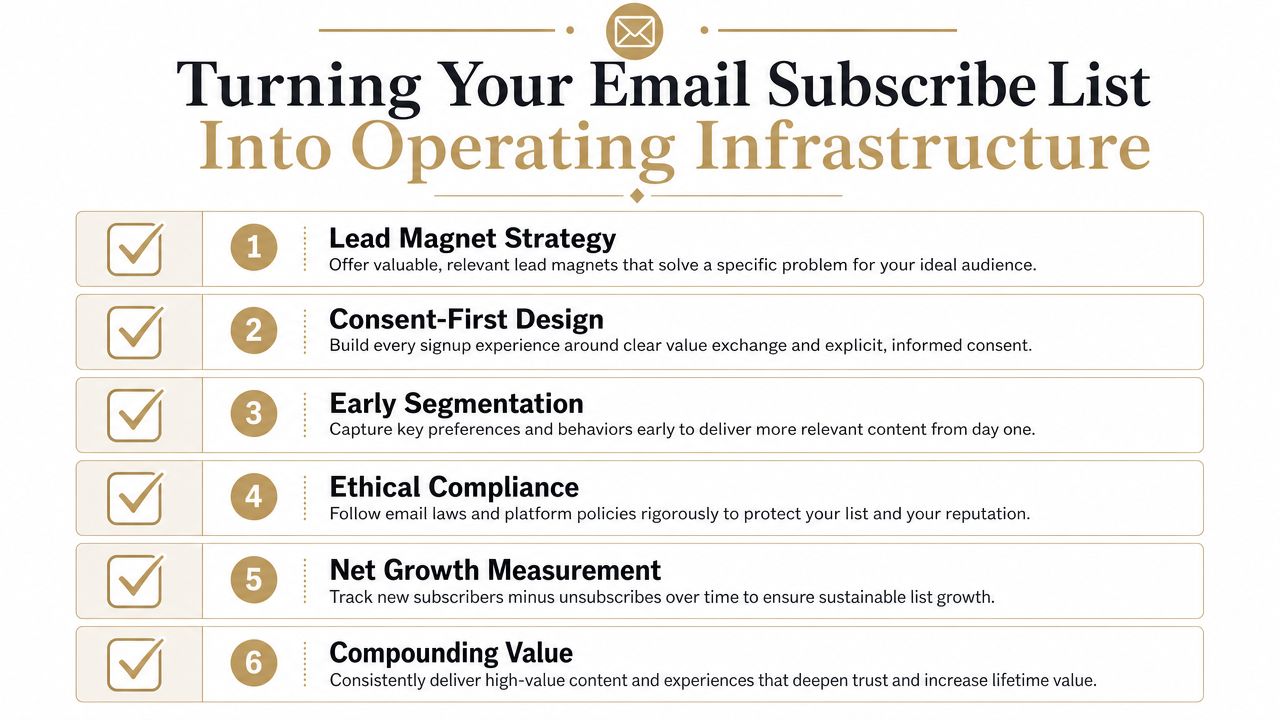
The Monday-morning move is not to chase another tactic. It's to pick the list quality lane you're willing to operate in, then align the form, the content, and the cadence to that choice. If the wrong people are joining, tighten the offer. If the right people aren't converting, reduce friction only where it doesn't damage fit. If the list is growing but engagement is sagging, the problem is usually not volume. It's mismatch.
Watch for two failure modes over the next 90 days. The first is vanity subscriber count, where the team celebrates raw growth while the audience gets colder. The second is acquisition-only thinking, where nobody accounts for decay, churn, or how quickly a list can hollow out.
A quick quarterly check keeps the system honest. Review your sign-up promise, your consent language, your segment routing, your welcome sequence, and your net growth math. If one of those pieces is weak, fix it before you spend another month pushing traffic into a leaky bucket.
NewsletterAsAService plans, writes, designs, and sends weekly B2B newsletters for professional services firms, which makes it a practical option if you want your subscriber list to support actual client communication instead of sitting idle. If you'd rather build a list that stays compliant, segmented, and worth emailing, visit NewsletterAsAService and see how the service fits your firm's weekly cadence.
Done-For-You
We write the newsletter. You stay in front of your clients.
One flat rate at $399/mo. Research, writing, and formatting handled for you, in your voice. First edition free.
Get a Free SampleRelated